Wednesday, April 22, 2009

Heaney at 70


RTE's Heaney at 70 site

My own introduction to the box set of the Collected Poems

Irish Times special feature

Excellent review by Barra O Seaghdha of Stepping Stones
Thin-skinned dreams: Reading Friederike Mayröcker


(with thanks to Poetry Ireland Review, where this first appeared)


Friederike Mayröcker, Raving Language: Selected Poems 1946-2006. Translated by Richard Dove. Carcanet, 2007.

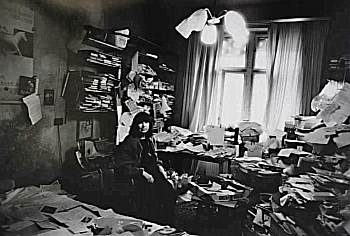
Some facts first: Friederike Mayröcker was born in Vienna in 1924, worked as an English teacher from 1946 until 1969, since when she has lived as a freelance writer. She began writing in her teens and was first published in the Viennese avant-garde magazine Plan. From her beginnings as a writer she has been associated with the Wiener Gruppe, figures such as Hans Weigel, Andreas Okopenko, H.C. Artmann and her companion Ernst Jandl, whom she met in 1954. Since giving up her teaching job she has lived, in Jeremy Over’s words in a recent (Autumn 2008) issue of New Books in German, ‘an almost hermetical existence surrounded by unruly mountains of books, papers and notes in a tiny flat in the Zentagasse district of Vienna. . .’ where she ‘started to produce the main body of her extraordinary avant-garde literary work.’

The unruly piles of books and papers are reproduced on the over of Richard Dove’s translations of her work in Raving Language: Selected Poems 1946-2006 (Carcanet, 2007) in a mixed media piece by Linda Waber from 1995. Atelier Friederike Mayröcker is an impression of the kind of romantically fruitful artistic disorder beloved of the public – think of the Bacon Studio in Dublin – but it offers us an image of the working method that might help us if we don’t take it too literally. The piles of papers, painted as generic clutter, may have a perfectly rational coherence for the poet. The space is tiny and the stuff seems to be bursting out of it, as if it can’t be contained; and almost a quarter of the scene is dominated by the buildings of Vienna visible from the poet’s apartment, and that in itself is a useful image: the city spilling in, perpetually available to the avid eye of the poet. Vienna is crucial to Mayröcker; to a great extent she writes with the city. In an interview she has said that she can only write in Vienna, and described how during a six month residency in Berlin she found herself unable to write; she had to go home to Vienna for a weekend in order to write anything.


Avante-garde is a very general and maybe not especially helpful description. Mayröcker’s work is a kind of continuous torrent of freely associative, passionate language in the service of private obsessions; in the service, if you like, of the individual lived life rather than the life of the greater social entity. There is nothing specifically national or political in this work, nothing identifiably sociological. Its methods favour the apparently random: the habitual use of collage techniques which layer seemingly disparate levels of experience. But because it it so clearly rooted in the experimental tradition – she herself singles out the period between 1966 and 1971 as her ‘experimental years’ during which she concentrated mainly on the manipulation of language, on making explicitly concretist and Dadaist poems – her later work has little need of the obvious armoury of alienation and is in fact highly approachable.

The techniques which deflect or distract the reader from some kind of normal autobiographical expectation do in fact cohere – they cohere into what interests the poet, what engages her attention. They have in common a certain pitch of language, a certain emotional intensity. The pitch is influenced by the fact that the poems are often conceived as letters; they have specific addressees. Many are addressed to Jandl after his death in 2000 and the ‘raving language’ or ‘rasende Sprache’ of the title is a language of heightened perception that comes from the intensity of this address:

I’m writing deluded letters which you’ll never receive,
such thin and vulnerable skin-intercourse, this is merciful
weather, the whitethroat’s kiss in the gardens. . this
word in the wire in communion I’m dreaming of you, and
ecstasy itself, this magpie,
have just invented language raving language.


Hallucinatory and ecstatic, these poems seem to invent their own searing idiom. Mayröcker in this aligns herself with the tradition of Hölderlin, an important precursor for her, as indicated by Richard Dove in his excellent introduction to this selection:

...Hölderlin became a key point of reference in the 1970s, and ...she has deliberately adopted – or rather adapted – elements of his late hymnic style. Isolated phrases are taken over lock, stock and barrel. . . .But it is in terms of syntax that the affinity is greatest – Mayröcker’s primitivistic parataxis has a similar ‘Asian’ feel to Hölderlin’s (to cite the eighteenth-century distinction between ‘Asian’, i.e. non-classical, and ‘Attic’, i.e. conventionally neo-classical). In her mouth, parts of speech like aber (but) or nämlich (namely) have a decidedly Hölderlinian feel.

(Introduction, xxi)


Her poem about a visit to the Hölderlin tower in Tübingen begins with the striking image of the poet getting her Hölderlin fix:

Hölderlin’s Tower, River Neckar, In May

this snort of Hölderlin
in the bright-red Hölderlin room/
standing in the corridor
my glance falls on the red flowers in the glass
bordered by petals
shed
nothing else/
the room empty just the vase of flowers
two old chairs --
I open a window
in the garden, you say, the trees
are still the same as in his time
bur we hear a snatch of music the bluish
silverware is glittering

for Valerie Lawitscha


The suggestion of drug-taking is deliberate. In his note on the poem Richard Dove discusses his search for the best English rendition of the noun:

What is certain is that Hölderlin is a drug for this poet. During a conversation in Vienna in February 2005, I asked Mayröcker how she wished ‘eine Prise Hölderlin ’ to be translated – a pinch (as in ‘a pinch of salt’ or ‘a pinch of snuff) or a snort (as in ‘a snort of cocaine’). Her answer was instantaneous: a snort.’
xxviii


Her influences are eclectic, and derived from wide reading. Apart from Hölderlin she cites Jacques Derrida, Hélène Cixous, Roland Barthes, Marguerite Duras, Henri Michaux, Beckett and Gertrude Stein, but it's reading itself which is the real influence -- ‘Writing/is applied reading’ one poem announces briskly – and an inevitable spur to imaginative work. Writing about her in a recent New Books in German, Jeremy Over notes the importance of reading :

At Vienna’s Schule für Dichtung (‘Poetry Academy’), she recommended to probably horrified student writers that they read for at least ten hours a day. . .

(Jeremy Over, New Books in German)
http://www.new-books-in-german.com/english/316/220/220/129002/design1.html


The reliance on collage is one application of reading. Books provide an endless source of found material to be deployed and orchestrated. It’s the technique of an inward and remarkably self-contained sensibility.

In the same way that the late, fragmentary Hölderlin appeals, her imagination fastens on fragmentariness as if the rendering of the fragmentary were the only true way to engage with the world. Her poems are shot through with, and driven by a fierce sense of mortality and an accompanying determination to pack in as much of the world as possible. The work is visually rich; she is a very painterly kind of poet -- she has described herself as an ‘Augenmensch’, an ‘eye person’. There’s a kind of ferocity or a fierce anxiety about the way she crowds the visible into her lines; the eye that is in love with the world is acutely aware that everything looked at is vanishing and that its ecstasy is a form of grief:

….. I
only know this life
won’t be coming my way again, not I
my heart is grazing
in mournful pastures

(country rain, july)


A poem like ‘in praise of a fragment’ gets all these concerns in: the random, material world, ‘the thought of transience’, unstoppable joy and a deliberate inconclusiveness that is her particular fidelity to experience:


across the street
at two facing windows
a woman and a man call out
the state of the world to one another /
on the sliding roofs of containers for old glass
the sign with an arrow in three languages
hier öffnen open ouvert /
the thought of transience
gets me howling
while I tread the cobbles
beneath mimosa trees and the oriental
candyfloss wafts through open windows out into freedom /
lilac is blossoming in a small lane /
on rubber soles a youngster
is leaping through sudden May rain /
the young robinia leaves torn down in a nightly storm
are swimming on the surface of a lustrous
puddle / gesticulating
horse-drawn cart

with a pursed lip the apostrophe,


The rapt attention and inclusiveness are a by-product of ‘der Gedanke der Vergänglichkeit’, ‘the thought of transience’ that makes her howl. Inconclusion is the conclusion, and the grammar goes about its own independent business. We can see too in a poem like this how the freedom of the technique is a reined freedom; the method is associative, the laying down of apparently disparate layers, but the different layers reinforce each other, and add to the impact of the poem – an it’s a canny kind of associativeness, the randomness is judiciously selected. The poems are full of these kinds of moments of passing life caught in the sudden ecstatic glare of attention, with the language a headlong rush to capture them before they vanish:

in the effulgence of hair
this effulgence of hair in the window
hair-effulgence, never seen anything like it
reflection of a tail of blonde hair
in the front window of a car
hair-effulgence of a woman who remained invisible
eyes mouth nose chin not to be made out, just the angle
of the hair
blonde hair
(drum) dripping dropping of hair, chimera
in the morning

(effulgence of hair)

or

with windows flung open on the morning of a radiant
August day such an August day / to drink
the flowing air /still / tell myself I’m alive /still /
and now and here yet finitely
or through the blinding blue sails the finite
swallow


Some of the most attractive and striking poems here are those written about her mother in old age. The stark presentation of her mother’s mental disintegration is accompanied by the poet’s unshakeable sense of the world continuing on its way:


to spit around
the little prayer-mat
babble around throw one’s arms around
as though I were now her mother and she
my child. . . it’s all, she says, getting turned
inside out, she’d
expected more of old age, the world’s
lost its charm

meanwhile February shoots up
in mimosa plumage

(‘on this morning’)


This double or multiple focus is very characteristic of the work. In another of these poems the poet and her mother contemplate a tree outside the hospital window

is that a gingko tree, she says,
there’s something else you can write about
the nun looking after her
comes to her bed and says
do you want to confess and take communion tomorrow
and holds her hand
I say she’s without sin, always has been
the white-stockinged
finches among the leaves

(‘mother, eighty-three, hospital’ )


Through all the work runs the sense of poetry as a kind of continuous conversation – with the self, with writers, artists, friends, and with Ernst Jandl. They have the intimate form of letters – practically every poem has a specific addressee – and this accounts for much of their liveliness. It also accounts for their urgency, both in the sense that the poems move with the speed of letters written at speed, but also in the sense of felt pressure of something needing to be said. There are no half-measures – the rhapsodic pitch is sustained convincingly, informed by a rage against mortality that makes her ‘CLEAVE to this earth’.

At over two hundred pages, Richard Dove’s is a substantial collection but it still amounts, as he reminds us, to only about a quarter of her output. It makes a convincing case in English for this prolific and remarkable poet.

Thursday, February 05, 2009

Sandalwood comes to my mind


Carl Rakosi
from Excercises in Scriptural Writing

Sandalwood comes to my mind
when I think of you
and the triumph of your shoulders.
Greek chorus girls came to me
in the course of the day
and from a distance
Celtic vestals too,
but you bring me the Holy Land
and the sound of deep themes
in the inner chamber.

I give you praise
in the language
of wells and vineyards.

Your hand recalls
the salty heat of barbarism.
Your mouth is a pouch
for the accents of queens.
Your eyes flow over
with a gentle psalm
like the fawn eyes
of the woodland.

Your black hair
plucks my strings.

In the foggy wilderness
is not your heart
a hermit thrush?

Thursday, November 20, 2008

Sleepless in Argentina


Imagine a hand had reached down from the sky and lifted up Paris, Rome and Madrid, shuffled them and laid them out on a grid by the River Plate delta, and you have some idea of Buenos Aires. I’m here again for the first time in almost a decade and second time around the impressions are just as overwhelming. Nothing quite prepares you for the intensity of the city: the endless roar of the traffic, the teeming pavements, the sense that all fourteen million inhabitants of the Greater Buenos Aires have just poured onto the streets. The grid layout actually increases the din; cars, buses and taxis honk and weave down five lane streets in one way systems. Haussmannesque avenidas stretch for miles crossed by a seemingly endless series of parallel streets.

You move around it as across a chessboard, with two crossing streets as your map reference. I need to get to a bookshop on the other side of the city, where a translation of a selection of my poems is being launched. ‘Scalabrini Ortiz and Santa Fe,’ explains Gerardo, one of the two translators who worked on the book. When I produce the code in the taxi the driver nods and takes off without a further word and twenty minutes later I’m outside the bookshop. Dublin’s a fog, I think, here all is sunny clarity and logic. The taxi is cheap, but even cheaper are the plentiful buses and the subte, the oldest underground in South America.


Like a lot of Latin cities, Buenos Aires is both highly organised and essentially anarchic. You register the bustling modernity, the plentiful WiFi, the latest gadgets, but also the broken pavements, the rubbish, the villas miserias on the outskirts. For the tourist with dollars or euros, besotted by tango or the other excitements of the city, Argentina is cheap once you get there. For the locals, money is tight, salaries meagre and inflation is running, so unofficial sources claim, at 25% and public debt is huge. The biggest controversy while I’m there is President Cristina Fernandez de Kirchner’s plan to nationalise the private pension schemes to help the government’s cashflow problems. And what about the literary economy, I want to know, as we sit in a café eating empanadas, little pastries filled with meat and vegetables. This is after all the country of Borges, Julio Cortázar, Manuel Puig, Alberto Manguel, Juan Gelman and a host of newer voices, and the city is crammed with bookshops.

It also hosts the Buenos Aires International Fair, the largest Spanish-speaking fair in the world, and one of the most important cultural and publishing events in Latin America. Even in times of crisis Argentina has always had an enormous publishing industry, and a very high portion of the literary output is translation. But just as in English, the size of the industry can conceal some of the truth. A good deal of it is owned by giant global corporations not particularly interested in risk-taking. It falls to the smaller independent houses to publish emerging writers or to publish translations of literary fiction or poetry.

Jorge Fondebrider, the other translator of my book, has also just published a translation of Claire Keegan’s Walk the Blue Fields. Claire read from her work to an enthusiastic crowd in the Villa Ocampo just outside the city. ‘I’m pretty proud to say Claire was really understood by the audience here,’ Jorge says. ‘Because of the quality of her work it was important to introduce her among us.’ Translation has always been a vital engine of Argentinian culture. ‘We are a people that built a country with translations. As Borges said, we are, in a way, better Europeans than the Europeans: we don’t need to choose just one tradition, we can have all the different European traditions plus our own.’ Gerardo recently translated Declan Kiberd’s Inventing Ireland and a selection of John McGahern’s stories. ‘Remember that it was here where Joyce was first translated into Spanish, and where Beckett’s plays were staged for the first time.’ However it’s often difficult for publishers here to afford the rights for foreign fiction, and to commission translations. This is where an institution like Ireland Literature Exchange makes a big difference, and pretty much everything from Ireland recently translated has been aided by ILE.

Ideally, of course, translation should work in both directions. As I listen to the poets from all over Latin America reading at the Rosario Poetry Festival, I’m struck again by how much little we see of this work in English, and how much we miss. Sitting at a café table in the small hours later, watching jacaranda leaves fall into the glass and struggling to keep up with the frenetic pace of the conversation, I make another resolution to get back to the Spanish grammar book in the suitcase. Beside it, as an extra incentive, is a copy of Jorge’s anthology of contemporary Argentinian poetry, just published in Santiago. How does he do it? This is the answer, I think as another coffee arrives: a sack of caffeine, soupy summer heat and a thimbleful of sleep.

Tuesday, July 08, 2008

Shuntaro Tanikawa


Museum
stone axes and the like
lie quietly beyond the glass

constellations rotate endlessly
many of us become extinct
many of us appear

then
comets endlessly miss collision
lots of dishes and the like are broken
Eskimo dogs walk over the South Pole
great tombs are built both east and west
books of poems are often dedicated
recently
the atom’s being smashed to bits
the daughter of a president is singing
such things as these
have been happening

stone axes and the like
lie absurdly quiet behind the glass

Shuntaro Tanikawa

from The Selected Poems of Shuntaro Tanikawa, Translated from the Japanese by Harold Wright. North Point Press, San Francisco 1983.

Sunday, June 22, 2008

Charles Reznikoff


The Poems of Charles Reznikoff, 1918 – 1975. Edited by Seamus Cooney, Black Sparrow Books, 444 pp., $21.95

Poetic movements come and go and leave in their wake a few historical traces and a few poets whose practice may have been partially shaped by their allegiance. Few have left as interesting a residue as the set of gestures within twentieth century modernism that have been labelled ‘objectivist’. Whereas Modernism proper was Euro-centric, high culture and Right-leaning, the objectivists were urban, American-oriented, and with the exception of Lorine Niedecker in rural Wisconsin, Jewish New Yorkers. The politics are important because they are very much bound up with the aesthetics. George Oppen was a labour organiser and a Communist and gave up poetry for twenty years in favour of social activism. These poets lived their lives on the margins, outside both of academia and the kind of economically successful life which might have rewarded them socially. Charles Reznikoff had a succession of small jobs; Lorine Niedecker washed floors in a hospital; Oppen worked as a cabinet maker in Mexico for twenty years; Louis Zukovsky had a variety of jobs including a stint working on a history of American handicrafts with the Works Projects Administration.

Zukovsky was the animator of objectivism and his role as a kind of mediator of modernism, an important advocate of Pound and Williams as well as of the objectivists, combined with the intelligence and virtuosity of his poetry, has always ensured him his share of critical attention. Reznikoff on the other hand is less well known in the wider world, though Seamus Cooney’s gathering of nearly sixty years of his work should change this. Reznikoff is the kind of poet who can all too easily slip between the cracks because he was content to mine his own corner of the world, and because the poetry and the aesthetic which underlies it are self-effacing. He is supremely a poet of the city, an observer of its scenes and people, a chronicler of the struggles of immigrant Jews in the new world. The poems are full of the kind of precise detailing that is normally reserved for fiction or memoir; they open themselves up fully to the experiences of others, and keep the poet’s self out of the business. As well as his natural affinities with the objectivist principles he has learned from sources as diverse as Whitman, Pound, Goethe, this may have been partly due to his reading of translations of Chinese and Japanese poetry. In an essay included by Seamus Cooney he quotes a pamphlet on Japanese art,


‘For Zen, in the search for illumination, that is to say, immediate contact with the essence of the universe. . . puts the strongest emphasis on personal effort and forgetfulness of self.’ (his emphasis)


Reznikoff’s natural sympathy with a self-forgetful poetry that restricted itself to the evidence provided by the world is enhanced by his legal training – poetry was always testimony for him – and his love of walking. Reznikoff walked anything up to twenty miles a day every day of his life and it’s no accident that one of his collections is called ‘Going To and Fro and Walking Up and Down’. The New York he saw on his walks fills his poems, but the observation also provided the method: a focus on brief moments in lives and as much as possible releasing the potential of what is seen. This is what he understood by ‘objectivist’.

‘By the term “objectivist”, I suppose a writer may be meant who does not not write directly about his feelings but about what he sees and hears; who is restricted almost to the testimony of a witness in a court of law...’


One aspect of this is a kind of deadpan kindly noticing and recording, as in a poem on Cooper Union Library:

Men and women with open books before them --
and never turn a page: come
merely for warmth
not light.


The poems are also remarkable for the way in which the city is a continuous living and radiant presence for him; nature is always framed by the human machinery of the city, ‘clouds, piled in rows like merchandise’. Streetlamps, subway stations shine in the poems with the pure force of attention, ‘those little islands of existence which Rezi saw with so much love’, as George Oppen put it:

Coming up from the subway stairs, I thought the moon
only another street-light--
a little crooked.
(Jerusalem the Golden, 20)

Walk about the subway station
in a grove of steel pillars;
how their knobs, the rivet-heads--
unlike those of oaks--
are regularly placed;
how barren the ground is
except here and there on the platform
a flat black fungus
that was chewing-gum.
(Jerusalem the Golden, 18)


If he sees the clouds and the lights he also records how ‘the milliners, tacking bright flowers on straw shapes,/say, glancing out of the window,/ It is going to snow.....’ Reznikoff isn’t a soft-hearted urban pastoralist; there’s always someone working, always a keen sense of the life within the city; factory chimneys are his cedars of Lebanon, and livelihoods are often precarious. The early self-published books are full of vignettes of families on the brink of disaster: this is the New York of immigrant pushcart peddlers, garment makers, boarders and broken English. One offers a version of a family story that had large resonance for Reznikoff – the destruction of his grandfather’s poetry. In the poem, after the unnamed business man dies his children find ‘the manuscript so carefully written and rewritten’, scribble on it and tear it up. ‘At night the mother came home and swept it out.’ That vision of an inner life extinguished may well have intensified the poet’s desire to record the life of his city and his people, almost as if that registering and recording might somehow restore the voice of the lost. And it may have been one of the engines behind the sturdy materiality of the poetry, built up layer by layer like a patiently accumulated testimony.

The work is often arranged into groups of poems where the poems are numbered but usually untitled. These groups often have desultory titles as if any overt principle of organisation from detract from the democracy of the discrete poems. Thus 'A Fourth Group of Verse' (1921) or 'A Fifth Group of Verse' (1927). The former consists of forty eight short poems, scenes of city life and, indirectly, autobiography. Many are memories of childhood:

When I was four years old my mother led me to the park.
The spring sunshine was not too warm. The street was almost empty.
The witch in my fairy-book came walking along.
She stooped to fish some mouldy grapes out of the gutter.
(3, ‘Beggar Woman’, CR 29)


Five simple sentences in four lines, the childlike perception and certainty of the final two lines... The deadpan method of presentation allows for a rich build up of detail, or urban detail in particular, so that the method allows the city to enter and inhabit the poems in a way a more figurative approach might have prevented. There’s a joy in these accumulations, a material denseness as the city unfolds itself in the mind:

After dinner, Sunday afternoons, we boys would walk slowly
to the lots between the streets and the marshes;
and seated under the pale blue sky would watch the ball game--
in a noisy, joyous crowd, lemonade men out in the fringe tinkling their bells beside their yellow carts.
As we walked back, the city stretched its rows of houses across the lots--
light after light, as the lamplighter went his way and women lit the gas
in kitchens to make supper.

(‘A Fourth Group of Verse’, 17)


The lemonade men with their yellow carts, the stretching rows of houses, the lamplighter and the women in the kitchens....it’s an evocative tableau, all the more so for the absence of evaluative commentary.

Swiftly the dawn became day. I went into the street.
Loudly and cheerfully the sparrows chirped.
The street-lamps were still lit, the sky pale and brightening.
Hidden in trees and on the roofs,
loudly and cheerfully the sparrows chirped.


The resolute cheerfulness of tone is also a kind of protective mechanism. The childhood world evoked is often grim – poverty, violence, uncertainty:

His parents had lost their money. They sold the house and were to move away.
He went up to his room for the last time.
The trunk of the tree, branches and twigs were still.
He thought, The tree is symmetrical. . . and whatever grows . . .
in shape. . . and in change during the years. So is my life . . .
and all lives.
He went down the stairs singing happily.
His father said, “There’s so much trouble – and he sings.”

( ‘A Fourth Group of Verse’, 22)


Going down the stairs singing happily might be a figure for what the poems do a lot of. He is not too interested in going beyond the contingent, or in dwelling too long in any particular part of the canvas. He moves swiftly through his subjects, notebook in hand, working quickly and with complete conviction that his kind of attention will yield its own rewards.
His city is a perpetual theatre, where anything can happen, and poetry is always within reach:

What are you doing in our street among the automobiles, horse?
How are your cousins, the centaur and the unicorn?

or

Among the heaps of brick and plaster lies
a girder, still itself among the rubbish.
(‘Jerusalem the Golden’, 69)


He stops at the point where a lot of poems might think of beginning, and though the poems are worked and economical they are not concerned with their own perfection; he's quite content to scatter his poems and let the best of them survive if they can

Of all that I have written
you say: "How much was poorly said."
But look!
The oak has many acorns
that a single oak might live.
(Just Before the Sun Goes Down, 1)


Maybe one of the most attractive aspects of his work is precisely his preparedess to let it be, to let the city come alive in his alert, amused and humane seeing of it. His habit of constant seeing, constant attentiveness produces an unmissable poetry of the city and this book should ensure that a decent grove of it will live.

Featured post

Call for applications for the Kavanagh Fellowship, 2021

  Call for applications for the Kavanagh Fellowship, 2021 Trustees of the estate of Katherine Kavanagh ,  3 Selskar Terrace, Ranelagh, Dubli...